
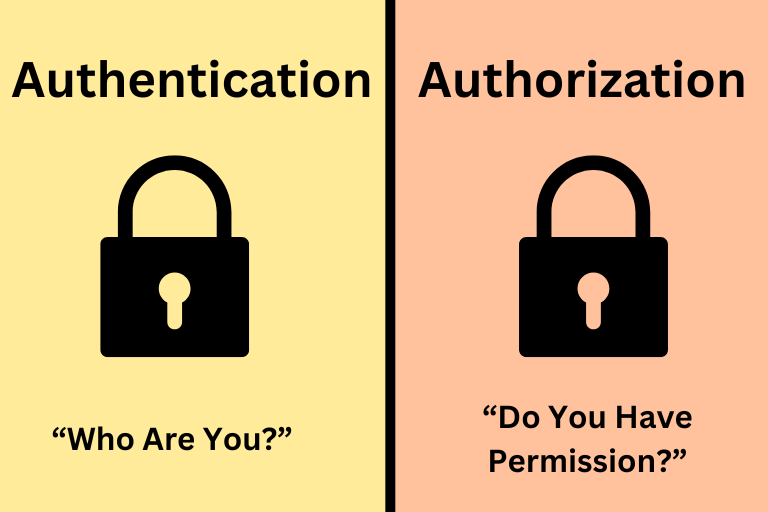
Let’s not kill you curiosity with the long paragraphs, The answer to the question that “Are Authentication and Authorization same concepts?” is No, Authorization and Authentication are not the same concepts, They have a different meaning as well as a different functions. Now let’s understand the difference between them in detail.
#Key Differences Between Authentication & Authorization
| Authentication | Authorization |
|---|---|
| Here, System determines who the user actually is? At this step, User is unknown. | Here, System already known the user & checks if this particular user has access/Permission to the particular resource he/she is trying to access. |
| Authentication is done before Authorization. | Authorization is done after Authentication. |
| Challenges the user to validate credentials (for example, through passwords, answers to security questions, or facial recognition) | Verifies whether access is allowed through policies and rules |
| Example: User is trying to login to an application through login page, Here user is actually doing the authentication, System will verify is this user exists & will take the user to next step if yes, Otherwise display a “User Not Found” error. | Example: User is already logged in and is trying to access payments page, System will check if the user is given access to payments page by the administrator (Owner of the application), If yes, User will be redirected to payments page, Otherwise “Forbidden” error will be shown to the user. |
#What is Authentication?
This step takes place when the user is known to the system, System doesn’t know with whom it’s interacting with, This step is necessary for security so that correct user is logged in. Authentication is the process of verifying a user’s identity before granting access to a system, application, or website. It ensures that only authorized users can access sensitive data or perform certain actions. Common authentication methods include passwords, biometrics, OTPs (One-Time Passwords), and multi-factor authentication (MFA). It differs from authorization, which determines what actions an authenticated user can perform. Authentication can be implemented using protocols like OAuth, JWT, and LDAP. Strong authentication enhances security and prevents unauthorized access. It is a crucial part of cybersecurity for protecting user accounts and sensitive information.
#What is Authorization?
This step takes place when the user is known to the system, System knows with whom it is interacting but still needs to confirm of this person can access a particular resource. Authorization is the process of determining what actions or resources an authenticated user is allowed to access within a system. It defines permissions and access levels based on roles, policies, or rules. Common authorization methods include Role-Based Access Control (RBAC) and Attribute-Based Access Control (ABAC). It works alongside authentication but is a separate process—authentication verifies identity, while authorization grants or restricts access. Authorization can be implemented using tokens, access control lists (ACLs), and security frameworks like OAuth. Proper authorization ensures data security by preventing unauthorized actions. It is essential for enforcing access control in applications and systems.
#Conclusion
Authentication and authorization are fundamental security mechanisms that work together to protect systems and data. Authentication verifies a user’s identity, ensuring they are who they claim to be, while authorization determines their level of access and permissions. Both processes are essential for preventing unauthorized access and ensuring that users can only perform actions they are permitted to. Implementing strong authentication methods, such as multi-factor authentication (MFA), along with robust authorization models like Role-Based Access Control (RBAC), enhances security. Together, they form the backbone of access control in modern applications, safeguarding sensitive information and preventing security breaches.